

No More Blue Skies
Impressions from Beijing during the Trump-Xi visit

Earlier this year, I played travel Tetris, and I decided visit Beijing for a bit between two professional engagements–one in Bratislava, the other in Taipei. After my last time in the city, I felt like I had a lot left to explore, and I was curious about the comments and messages readers left me — how in only six months some things had already changed. A lot had changed in my life, in the U.S., in China, and the world since I had last been there. What would it be like returning under these conditions? I had to see it for myself.
I didn’t expect to overlap with Trump’s visit, nor his controversial remarks immediately after as I was set to meet with leaders in government, civil society, and academia for a week in Taipei. Much has been written about the Trump-Xi summit, but few people were in these two places around the time it happened. My hope is to add to the conversation through my impressions of admittedly extremely short trips in very specific cities that are not necessarily representative, and beyond purely policy perspectives.
This first post is about Beijing. The next one will focus on Taipei, so I will keep any discussions regarding Taiwan for that one. As always, take what I say with a grain of salt, and I’m open to being wrong. This was but a short trip, but at a time with limited on the ground information, I hope you can find something valuable.
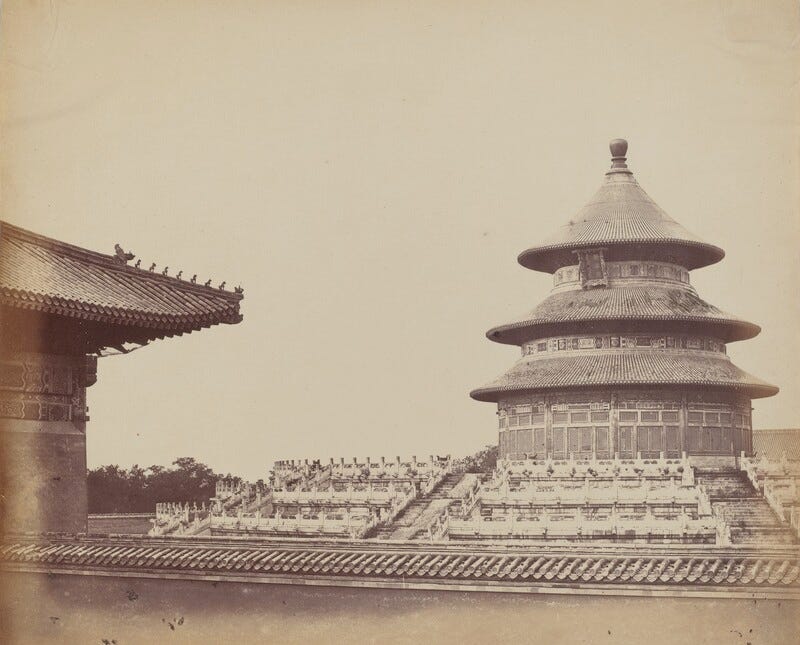
I. Beijing, Between Blue and Beige
My friends and I joke that any attempt to return to China after leaving in 2016 was followed by a curse. Every time I have planned to go back, something pivotal happened in U.S.-China relations. In early 2017, a grad school project forced me to cancel a conference trip — Trump came into office around then and cemented a confrontational tone for the next two terms. In March 2020, I was meant to visit friends just as COVID hit the U.S., flights got canceled, and the country closed. By 2024, my friends and I had started wondering what would happen if I actually went. Some joked that going during an election year would jinx it and Trump would win. Lo and behold.
Nearly two years later, I had almost forgotten about the curse. The flight got booked, and a few weeks later Trump’s rescheduled Beijing dates perfectly coincided with my time in the city.
So, I may indeed be cursed. Apologies in advance to everyone affected by U.S.-China relations. It wasn’t Trump, Xi, or COVID — it was all just me and whatever witchcraft I left Beijing with in 2016.
But at least I knew exactly how everything would go while I was in Beijing this time. Or so I thought.
***
When I lived in Beijing, three things would always happen during a high-level visit:
First, the traffic would be terrible. Big thoroughfares would close to make transit seamless for the VIPs at everyone else’s expense.
Second, the internet would suck. VPNs would stop working. Social media would be under special scrutiny, becoming painfully slow and with increased censorship making it impossible to post anything that could be remotely related to the visit, even by a stretch.
And third – the only silver lining – was that the skies would turn blue. In preparation for the visit, Beijing would put its best face forward and the city’s distinctive smog would hide away for the duration of the visit.
Beijing was notoriously polluted, especially when I lived there. I “survived” the infamous 2013 airpocalypse where the smog was so intense I could see a beige cloud inside my apartment that left a constant taste of burnt plastic in my mouth.
Air pollution is insidious. You may not notice it at first, or notice how it’s affecting you until much later. I grew up with it, spending most of my formative years in Mexico City – another metropolis with famously bad air that worked hard to improve its situation. I always had sympathy for this unfortunate aspect of living in China, although arrogantly and stupidly, I thought having grown up in a polluted city would make me “less sensitive” to toxic particles when I first moved there – a time before my frontal lobe had not fully developed. I barely used face masks my first year in Beijing, and spent each year becoming increasingly sickly. I also developed respiratory issues, including seasonal allergies, and a tendency to regularly get colds despite not having been exposed to such levels of pollution in a decade. I didn’t experience any of this, or at least not to the same extent, prior to living in China, but the exact mechanisms of what happens to our bodies is unclear. The science on what long-term exposure does to bodies is still thin, and I may never fully understand what those years of not taking better care of myself cost me.
For Beijing, pollution was always a point of embarrassment. It was visible, left a plastic taste in your mouth, and it was something that they had trouble controlling. Plus, it got terrible media attention, especially in the west – China’s pollution was often used to exemplify broader criticisms with the government or China’s development model: an authoritarian, top-down approach forcing development at the cost of humanity. Pollution and authoritarianism work in similar ways — they creep up on you, become the new normal, and eventually start choking you. It made for a compelling illustration, whether you agreed with the analogy or not.
So before important visits, the government would find ways to lessen, if not eliminate, pollution; whether it was closing factories in the area, making it rain beforehand, or coming to some sort of divine agreement with the weather gods, Beijing ensured that it looked good.
Since I left, Beijing’s “weather” has significantly improved due to a variety of policies enacted by the city, and when I visited in 2024 I was pleasantly surprised by the air quality. Fixing the air for a high level visit would be even less of a lift than before. I even prepared my visit for this reality. Even though it may be harder to get around, I was looking forward to seeing a beautiful Beijing and perhaps even going out to touch grass with some friends far from wherever the Trump-Xi meetings would happen.
***
During this latest stay in Beijing, only one of the three things I thought would happen did, in fact, happen. Traffic was, indeed, terrible. A friend told me some of their colleagues were an hour or two late because of road closures. I was right to avoid the areas the Trump-Xi meetings would be in like the plague – near the center of the city, between Zhongnanhai and the Temple of Heaven.
On the second point, I actually can’t fully confirm whether the internet was funky because I’d decided to disconnect — there was no VPN on my China phone – only pure, unadulterated, Chinese internet. VPNs and/or access to foreign sites could have been working worse than usual and I wouldn’t have noticed. But my Chinamaxxing internet and phone worked like a charm – things loaded quickly, which was less common during events like these back in my day.
The only thing I was looking forward to about this visit – pristine air – was not there. And it wasn’t only hazy, as in bad weather–it was polluted with the AQI surpassing 150 for the entirety of my four days in the city. After my last visit, I had almost thought that Beijing didn’t get this polluted anymore. In some ways it was almost comforting that Beijing hadn’t changed so much, at least in this regard. The city was shinier, more organized, and missing a lot of what I’d loved about it — but it still had cracks, just not the ones I’d missed.
But why, after so much effort in improving Beijing’s image, let these cracks show during such a time? There was such a disconnect between my prior experience with VIPs visiting China that I wondered if there was a reason behind it. Was this a deliberate slight? I asked friends what they thought, and they told me something that I found even more profound: since COVID, China no longer ensures blue skies during high-level visits.
I find this fact emblematic of what China has become since COVID – scarred, jaded, but also with no more need to impress anyone. China has risen, and it doesn’t need to suck up to anyone. Don’t like our polluted air? Don’t breathe then.
II. Through the Haze
It’s difficult to come up with full conclusions after only four days in the city, but here are some impressions based on what I was able to make sense of during my short stay there. Specifically, I will discuss the foreigner/tourism infrastructure as a follow-up to my previous piece, some reflections on being in Beijing during the Trump-Xi summit, and some observations about AI in China.
A. Return of the Laowai
After my last piece -- which I wrote six months after visiting, or three years in China-time -- a lot of people commented that the friction points surrounding non-resident foreigners visiting the country I’d had were now seamless. I wanted to see if that was true. And to add an additional layer of difficulty, for the first time in my life, I was on a plane where the majority of people were foreigners, mainly from central and eastern European countries.
The first test was the visa-free policy. I’d never been to China visa-free, and anyone who’s applied for a Chinese visa knows it can be a stressful experience. There’s always a sense that maybe you won’t get it this time due to some arbitrary policy or Beijing deciding that they don’t like you at this point in time. Everyone has heard about people getting rejected for random reasons. You also don’t know how long it’ll take, or how diplomatic relations will affect the process. So the idea of going to China visa-free felt fake to me, even though the policy is real. Part of me couldn’t relax until I’d passed immigration.
What I saw at Beijing Capital International Airport at four in the morning made it clear that the policy and the infrastructure to support it have not quite caught up to each other. Even if I did pass through pretty seamlessly and visa-freely, a lot of it had to do with my knowing what I was doing. I’ve China’d before. A lot of my plane clearly hadn’t.
Here is what I think about countries and travel difficulty. Level 1 is pretty seamless tourist infrastructure, basically made for dummies. You can plop yourself down and figure it out. Level 2 mostly works, but you can’t expect anyone to hold your hand. You can use your credit card most places, but you might need to do a little research on logistics. Level 3 is where you need to do real research. The payment systems are different, the apps are different, what you’re used to isn’t what’s there. There are also much harder levels than level 3, but you get my point.
China is solidly Level 3. Before you come, you need certain apps because most places won’t take your credit card, and a lot of places don’t accept cash. You pay through Alipay or WeChat, and Alipay is the one foreigners can use because you need a domestic bank card to use WeChat. You connect it to your credit card and pay by scanning QR codes. You also need a bunch of other apps in the Chinese ecosystem. Depending on your sensitivities, you might not want any of these on your regular phone — I use a separate one for China. If you’ve never experienced this level of travel-prep, you don’t realize how many countries fall into it, and you can be in for a rude awakening.
I was watching that rude awakening happen in real time at four in the morning. The flight had landed at an hour where things should move fast, but instead it was chaotic. The arrival area gave off the same vibe as those M.C. Escher drawings with a variety of stairs going everywhere and nowhere, overstimulation to the point of creating a haze. Signs and stairs and pathways that hadn’t caught up to the reality the policy was promising. Most people didn’t know they had to fill in an arrival card beforehand (hint: do it beforehand online to avoid this mess). There were signs, but unclearly placed. There were also confusing signs pointing to the 24-hour visa-free area while most of the visa-free travelers on my plane had a full 30-days, yet there was no sign of a 30-day visa-free counter. Airport staff had to divide and conquer various groups of foreigners that were lost to guide them to the right areas. I just went through the regular foreigner line, and there were so many foreigners that they split us off and sent us through the Chinese nationals line — which I had never experienced before. And I heard people, over and over, getting upset that they couldn’t use their credit cards, that they didn’t want to download an app, that they didn’t have this app, what is this app that you are forcing onto me.
***
My sense is that China is trying to do what Japan and South Korea have done in the past few years — attract a lot of tourists as a way to make up for the economic downturn. Both countries have built up a large infrastructure to absorb this—more signs in English, more visa-free policies, tax refunds for foreigners, translators in key locations, explanations at the airports, and so on. For China, the visa-free policy is the first step, but the infrastructure and support to make it work for less experienced travelers, or travelers who aren’t familiar with China, is still lacking. You’re welcome to come, but you’re going to have to figure it out yourself.
A few things still feel like they need to catch up to the visa-free push. Foreign credit cards through Alipay still can’t pay everyone. Not all shops and people are allowed to receive that kind of payment. People are very kind and resourceful about it — usually someone nearby will let you scan their code and then they’ll pay the shop for you. But that’s people’s kindness papering over infrastructure gaps. And there are far fewer English signs than there used to be. I personally don’t mind, because I speak and read Chinese, but for the people I was watching get frustrated at the airport because they couldn’t use their credit cards, I had no idea how they were going to get around. If you didn’t even do enough homework to figure out payment, you’re going to have a hard time.
Another point that gave me the sense that China is trying to build a similar tourism infrastructure to its neighbors is the presence of tax-free booths in high-end malls, such as those in the Wangfujing shopping district. That said, the booths only applied to a select few foreign brands, not to any local brands. I also didn’t see the booths in other high-end shopping areas, such as Sanlitun and Guomao (granted, I may have just missed them, but if they’re there they definitely weren’t as visible). I was also struck by how empty the malls felt compared to how they used to be and the fact that there were no foreigners in any of them, even the ones with the tax-free booths. This idea was further cemented when I visited Seoul a week later for Memorial Day weekend on my way back to the U.S. – there were malls everywhere, tax-free infrastructure integrated into payment in most stores, and everything always felt packed, even during work hours.
***
There were way more foreigners in Beijing than the last time I came. Last time it felt like there were none. There still aren’t nearly as many as when I lived there — the number of foreigners in Beijing feels more like the number I’d have seen in a second-tier city like Tianjin or Xi’an back in my day. But it’s noticeably more than 2024.
A big chunk of the foreigners I did see I overheard speaking Chinese. They were probably people like me — more familiar with China, maybe lived there before (or had never left), maybe had family there. I also saw a decent number of tourists, especially at 798, a former factory turned into an art district. I didn’t see many anywhere else, and I didn’t see foreigners in the various malls I went to. The languages/accents I heard foreigners speak were Singaporean English, British English, Dutch, German, Korean, Japanese. I only overheard an American English accent a couple of times in my hotel. Most of the foreigners in my hotel also came from Asia or different parts of China, rarely from “the West.”
This also made me think of one of the frustrations I used to have about living in Beijing – it was terrible for learning Chinese. Beijingers always spoke English better than I spoke Mandarin, which made conversations also default to the former instead of the latter. I used English to speak with friends that I have a relationship with already in English, but in my day-to-day I almost never used it. Very, very different from what things were like last decade. Now, I actually think that you could improve your Mandarin by living in the city.
B. Watching the Trump-Xi Meeting on Douyin
While in Beijing, I kept my online activities to my China phone – without even a VPN. This was in part for cybersecurity, in part to disconnect, in part to see what the information environment looked like during the Trump-Xi meeting if I were disconnected from news outside of China. I also equipped myself with a Chinese sim card, which led to me finally being able to make a Douyin (Chinese TikTok) account.
I am an extremely online person and I love doomscrolling on TikTok. I am not proud of it, but it’s true. And I believe it contributes more to my brainrot than any AI. But I digress.
What I like the most about TikTok is how, once you invest sufficient time (~30 minutes of deliberate scrolling) it learns you and the algorithm becomes very personalized. I wondered what my algorithm would look like after spending half an hour on Douyin – who would it think I was, what content would it feed me, and what would it show me (if anything) about the Trump-Xi meeting.
I don’t think Douyin fully figured me out, but the Trump-Xi content came almost immediately. The first videos I got about the meeting itself were the choreographed ones. Xi and Trump walking together. Xi giving a speech about global stability and welcoming Trump. And then some Trump gestures. You’d see Trump’s lips moving, but you couldn’t hear what he was saying. There would always be a narration over a supercut of Trump gestures, some clearly not from the meeting. No video, in my entire time in Beijing, on any of the days I was on Douyin, showed me what Trump actually said. I would have never found out if my information was limited to Douyin.
I did eventually see Marco Rubio, which was surprising given China and Rubio’s mutual animosity – but I guess his presence in itself, as many have discussed, was an anomaly. Rubio’s words were mostly diplomatic one-liners that echoed some of the language Xi was sharing. One clip was him sitting and talking to camera, and there was a visible jump cut in the middle, showing that something had been edited out. But mostly, when it came to the U.S. side, it was clips of reactions, narration over the footage, not the U.S. delegation actually speaking.
Overall, if I were an average Chinese person scrolling Douyin, I would have no idea what Trump or Rubio actually said, or what was agreed on. I’d see Xi giving an inspirational speech and a supercut of Trump making funny gestures. Apparently the funny gestures are very popular — friends told me they were watching it live in their office and everybody was laughing at Trump. Again, nothing discussed about the substance of the meeting.
I figured I’d find out what was actually said once I left China. But when I did, the official readouts turned out to be their own kind of supercut. The Chinese version and the American one didn’t lead with the same things, didn’t include the same things, didn’t agree on what the meeting had even been about. The one phrase both sides put their name to was constructive strategic stability, which is the sort of language you reach for when you’d rather not say anything at all. Douyin showed me a Trump with no audio. The readouts showed me a meeting with no fixed shape. Depending on which screen you looked at, the visibility was equally low. Where the differences stood out came on the sides, on the interviews, on some specific agreements – but those will be addressed in another piece.
C. AI Everywhere All At Once
I’ve written about different attitudes towards AI in China compared to the West. I was curious to see if this trip would strengthen or challenge my impressions gathered from afar. However, for better or worse, AI was not really as big of a topic during my trip – in part because it was short, in part because I had non-AI-related plans, in part because I was catching up with people and I wanted to hear about their lives and not necessarily pry about their thoughts on AI. However, despite these caveats, here are a few observations that hint that AI, much like PM 2.5, is invisibly integrated everywhere from infrastructure to the social psyche.
First, I did not see as many AI ads as I thought I would. This doesn’t mean that there were no ads – this probably is more revealing of my expectations than any sign on how much China is advertising AI. Most notable was the large AI ad in the Beijing airport saying “AI is powered by Ali Cloud,” which is impossible to miss when you land.
However, this ad struck me as being rhetorically different from many AI ads in the U.S. In the U.S., I get constant ads trying to sell me AI chatbots, telling me different use cases, etc. I have not seen any ads highlighting Amazon Web Services’ or a data center’s role in powering AI, or ads about “AI” in the abstract, divorced from a specific company. In fact, this may be something to hide, given the current feelings towards AI. The Ali Cloud ad, to me, felt like it was framing AI as a national project, and it was supposed to be both technically impressive and societally significant that Ali Cloud was supporting it. In this sense, the ad served as both a commercial advertisement but also a form of government propaganda, which I found fascinating. Here is this national giant, Ali Cloud, bringing China to the AI future we are building towards.
Second, I did see more AI integrations in society than I’ve seen in the U.S. This is also not surprising since China is much more digitally integrated than the U.S. These AI integrations are small and invisible to the untrained eye, but you can see them usually in subtle adjustments that make technology more efficient, more accurate, more… surveillance.
The most notable example involved Alipay. In 2024 I had a lot of trouble with Alipay -- the app would flag my purchases as fraudulent and block my payments at least every other day. I’d have to send a copy of my passport, a picture of me, a picture of me with my passport, over and over and spend hours with a customer service chat asking for a human.
This time I only got blocked once, and the resolution was much easier and very obviously AI-enhanced in some way, although I am not 100% certain to what extent. I still needed to verify my ID. Instead of spending hours with customer service over chat and taking pictures of my passport, a window popped up prompting me to get on a video call. I accepted — and there was no person on the other end. Just me, and a live chat overlay on top of my video saying: Hi, please show your face, your credit card, and your ID, to make sure it’s you. I did. Then: Great. Okay. Bye. My card was then immediately unblocked. Was that completely AI? Was there a human anywhere? What level of AI was it? I don’t know. But it was much more sophisticated and much more convenient than what I’d dealt with before. It was also much creepier.
Third, I encountered AI on Douyin, and although there were many parallels with AI content in the U.S./Western social media, there were also some differences. For one, I was flooded with fan videos of Jensen Huang during the Trump-Xi visit. I learned more about Huang, his story, his TED talks, NVIDIA, etc., in half an hour on Douyin than I have in over a year writing about AI. He was treated like a celebrity – many videos showed crowds following him as if he were Justin Bieber or The Beatles, with hordes of people filming him on their phones as he walked around Beijing eating snacks. There were also, to a lesser extent, some admiring videos of Elon Musk and the other tech leaders in the U.S. delegation. In the U.S., any of these people, if recognized at all, would be just as likely to be hit by a molotov cocktail as asked to take a selfie given the current environment. I cannot imagine any of them being followed by legions of fans the way Jensen Huang was in Beijing.
To get a better sense of AI content on Douyin, I also kept on looking for AI takes, and I mostly found educational content. On U.S. TikTok, the applied AI content I get is usually focused on attaining some concrete goal or resolving a specific task: this is how AI helps me with my morning routine or this is how AI helps me run my solo business. On Douyin, some of the instructive videos were literally showing textbooks about how to use AI. It felt more technical, like a short-form Coursera, and a lot of it did seem to exemplify anxieties about being left behind, or needing to upskill on AI in order to compete in an increasingly depressed economy. I also saw less AI-generated content than I expected. Granted, I might just need more time on the platform to see where else the algorithm takes me.
Finally, in my four days in Beijing, I met with a lot of people. AI did not come up in our conversations. The only time it came up was when someone asked about my writing — Oh, you write about AI? How did you get into that? In the U.S., AI comes up in every other conversation I have with friends and colleagues, even without me bringing it up. There’s always a snarky remark about AI in the news, AI slop, frustrations with AI being pushed on people. This is not necessarily fully representative, as I was catching up with old friends and a lot has passed in the years since I saw them that are more important than AI, but it is still a data point.
All these observations also don’t mean that Chinese people don’t have gripes with AI – they do, and they are becoming more vocal. But perhaps it’s not being pushed down their throat in the same way, and/or the information environment limits and/or shapes how much and in what way frustrations with AI bubble up. That’s likely why reactions to AI may look, feel, and sometimes even be different than in the U.S.
III. Choking on the Same Smog
When you engage with people in an authoritarian context, whether it’s a political system, a cult, a family dynamic, you always need to get a feeling of what the boundaries are before discussing sensitive topics. What people do or don’t talk about, and in what ways they discuss things are data points. You also may not know what is a sensitive topic until you sense some awkwardness surrounding it – things that may be innocuous in one context may have different connotations in a different context. And goalposts can also change, meaning that something that may have been ok at one point could suddenly become political. There’s also a chance of potentially endangering the people you are interacting with by bringing up topics that are seen as taboo – if it gets back to the wrong people that they engaged with you, a person who discusses the no-nos, this could be used against them in the future.
I encountered some of this personally when I last lived in China. I led a feminist discussion group with some friends where we would meet monthly and discuss readings, podcasts, or film; the discussions were mostly academic, and many did not directly or solely focus on Chinese policies. Overall it was a great way to build an intellectual community around a topic that, at the time, was one of the areas that there was quite a bit of freedom to discuss – feminism was as much if not more of a vehicle because of the topic’s relative permissiveness than because members of the groups specifically sought out feminists to have intellectual conversations with. The topic was so non-sensitive that I even felt comfortable mentioning it to my students and inviting them to join in case they were interested. But one day there was a crackdown on feminist activists, feminism became more “sensitive,” and I had to rescind the invitations to my students out of caution. Some people even recommended that I disband the group because feminism was becoming a hot-button issue (I did not, and the group lived on. But it was always a thought in the back of my head.)
Because of this, I tend to follow a rule whenever I enter new contexts, especially those where speech can be weaponized against people: don’t be the first to bring up politics, especially those that may be “sensitive” in the context you are in – people can bring them up first and then I will attempt to match the vibe. This is especially true since I worked in government and may still be seen, even if I have left and have no current connection to it, as representative of a government. I’m opinionated — I’ll share, but only about U.S. domestic politics or foreign affairs that don’t directly involve China. For things that do directly involve China, I wait to see my friends’ comfort level.
And even then, I try to be careful – less so for myself, than for the people I am speaking with. Friends in industries that in democracies tend to be independent have reporting requirements akin to, if not more stringent than, government officials working on sensitive national security issues. I always tell friends to do what is best for them and their safety – the most likely worst case for me is that I may not be allowed in China again; a sad, but ultimately not devastating reality. That is not the case for people who have family and/or live in the country whose lives could be ruined over nothing. I am also aware that much worse could happen to me and has happened to foreigners, but currently I don’t feel like that is likely. Of course, that could change. Engaging is always a calculated risk that needs constant reassessment — but still nothing compared to what locals face.
Because of this, I didn’t ask much about the Trump-Xi meeting, and if people didn’t feel like sharing, I didn’t push. When it did come up, it was mostly logistical complaints. Ugh, I hate that Trump is coming, the traffic has been so terrible. And when I asked what people thought, the answer was some version of it doesn’t matter. Nothing will change. It’s all for show -- more cynicism than engagement. But I did get other insights reading between the lines, people watching, comparing with the China I knew well.
I’m also cautious when writing about China and the views of my friends. The impressions I write about in this section are anonymized based on various conversations with people in different industries, personal observations, and some conversations with people who are not physically in China but have strong ties.
A. Dysthymia with Chinese Characteristics
Similar to my visit in 2024, the sense I got is that the economy is depressed, people are depressed, China feels depressed. Not in a dramatic sense, but in a low-level, chronic, needs a small dose of Lexapro sense. It’s still China, a gigantic and dynamic country with millions of people, but not as energetic as the one that I got to know last decade. Part of this is normal: double-digit growth can’t last forever and there’s always a point where developing economies plateau. But the subjective feeling I picked up from people was negative about where things are headed.
When I talked about this impression after leaving Beijing with people on my way back, some asked, how real is it that China is depressed? And it’s a fair question. Statistically, materially, China is doing pretty well in a lot of ways. The world in general is not doing well, and China is a strong, developed country. But the subjective view felt consistent across people with very different perspectives and industries — a shared negative sense of where the country is going. And subjective views matter, often more than material reality. One friend said they were convinced there would be large-scale social unrest within the decade given peoples’ frustrations with the economy. People in China, especially after being closed off for a few years, aren’t traveling much, aren’t encountering foreigners much and thus have fewer data points from outside the country. They’re comparing China to previous China. And when you make that comparison, the situation can feel discouraging.
Compared to two years ago, more Chinese friends have openly shared with me their frustrations with the government. Part of this is likely because I no longer work in government, so engaging with me on these issues is likely less “sensitive” than it was before. But there’s also more frustration to increased authoritarianism than I felt when I lived there, akin to slowly choking. The friends I talked to described a kind of low-grade exhaustion of trying to manage real or perceived moving goalposts. Things that would be apolitical in any other context have been politicized. Self-censorship has crept further into ordinary life. The feeling came up over and over in different forms: that the air to act, to speak, to plan, has thinned out.
B. Breathing Constraints
As an outsider, beyond conversations I had, the most visible illustration of decreased freedom of speech was 798, where I hadn’t been in over a decade. For those who don’t know it, 798 is an old factory complex that was reconstituted into an art district. Most of the warehouses became museums and galleries. It is mostly modern art — paintings, sculptures, plus small quirky shops selling knickknacks. For anyone familiar with New York: Bushwick vibes, but in China; cheeky art that poked fun at propaganda posters, edgy shop inventory, hipsters everywhere.
China has always been authoritarian — there’s always a line you can’t cross in all forms of expression, including art. But when I lived there, you could still toy with the line. One of the last exhibits I saw before I left was an Ai Weiwei show, and one of the pieces consisted in a set of porcelain cups with Chinese characters painted on them that, if you sounded them out, said “Fuck Beijing.” You could be cheeky, as long as you were subtle and niche.
There are also fewer galleries than before. A lot of the spaces are empty, or filled with shops selling cutesy junk — random souvenirs, vintage stuff, but the “vintage” is printouts of Western posters. The political and social edges have been sanded off, and what’s left is decorative.
And within the galleries, the art falls into one of three categories:
(1) Abstract to the point of being conceptual in both visuals and meaning — you can’t really pinpoint what it’s trying to say, at least not as social commentary.
(2) Traditional Chinese art and aesthetic revival – great techniques, useful to nationalism, but staying within the confines of history and not the present.
(3) Labubu, or things that look like it; cartoonish, childlike, apolitical characters. Popmart has its own gallery there, which I actually think is a cool concept — supporting the artists that create the IP characters beyond just their character art, giving them space to explore and express themselves outside of creating toy lines, attracting new fanbases and customers through works of art rather than (only) collectible toys and trends. And throughout the art district you see different artists trying to replicate this aesthetic and success.
Combined, it all leaves a plastic aftertaste.
***
There were also a few things that were/are “taboo” that I saw more of than when I lived in China – new age practices and Chinese ethnic minority culture – that within specific confines were still allowed to develop.
In the West, there’s a Gen Z trend toward esoterica — tarot cards, witchcraft, alternative spirituality. Despite tighter controls on spirituality and superstition, China’s Gen Z also shows a strong interest in these issues and you see more products and experiences catering to this demand. In four days, I saw at least one tarot card shop per day. That’s still less than you’d see in any Western city, but for China standards, it’s a lot. When I lived there, the only tarot card place I remember was by the Drum Tower. It still exists, but now there are many more. I also saw shops selling artifacts related to Buddhism, of varying qualities. And a lot of artifacts related to bazi and feng shui, also at varied levels of sophistication — from cheap stuff to really beautiful, ornate, custom bazi jewelry with high-end prices.
In addition to the spirituality (and at times related to it) I saw many stores showcasing, selling artifacts from various Chinese ethnic minorities, particularly from Tibet, Yunnan, and Xinjiang. In the past these would be either in official provincial-run stores or in a few niche holes in the wall, but now there are high-end, largely visible, independent stores selling religious imagery and cultural artifacts from various cultures in China. That said, much like the esoterica described prior, it is all presented as consumer goods, and it is unclear to me how much space there is for people to practice or engage in spirituality beyond buying things or short experiences. And we shouldn’t ignore the fact that China, in many more important ways, is making ethnic minorities less visible.
Another space to breathe that I found interesting were these new, youth-oriented malls that were designed to be third spaces, such as The Box. This gave me flashbacks, not to China, but to my own teenage years — malls where people, especially teenagers and young adults, went to hang out. All of these malls, in addition to stores, had seating areas arranged for a group to sit in a circle. There were also more experiential activities in these malls, such as escape rooms, as well as bubble tea shops and restaurants – in part, I heard, because people don’t have the money to be spending in the shops. I did notice that the shops were comparatively empty, even if people were hanging out at the mall. This is a wild contrast to the U.S., where malls are mostly dead and depressing, and no longer a third space for people who are not old enough to go to a bar.
C. We Chinese Are More Used to Those Things
One of the characteristics I admire the most about Chinese people is their solidarity, at least within the people they consider to be part of their community. It most commonly takes form through creating interest-based groups, pooling resources, and sharing information. I remember when I moved from China back to the U.S. for grad school, I was invited to a WeChat group that current students and alums of the program had created where they shared class recommendations and reviews they had compiled from the group over the years and mentored each other–I was honored to be included, and the group was genuinely very helpful. As I mentioned previously, I also saw this solidarity during my visit with people helping me pay vendors that don’t have AliPay approval to charge foreign cards. In a lot of other countries, shopkeepers in a similar situation may have been just left to their own devices and we just wouldn’t have completed the transaction. This sense of community resonates with my experiences growing up in Mexico, so even if it takes somewhat different forms, it always feels familiar and comforting.
But some of the most meaningful expressions of this sense of solidarity can be more quiet and deeper – an emotional solidarity, recognizing the other’s humanity and one’s experiences in another.
***
There is an overlooked parallel between what is happening at a social, human level between the United States and China.
COVID in China radicalized several people in a way that is not fully reported, and given current constraints in doing research domestically, would be difficult to properly investigate. The policies were so draconian, people were so cooped up, and the fear and frustration were so rampant that it cracked government trust even amongst some of the CCP’s biggest supporters. To this day, I hear an underlying resentment towards Chinese authorities, whether explicit or between the lines, often stemming from COVID. And in the spaces where people feel safe, they will express their resentment openly and passionately.
A friend described how COVID forced conversations between people, family members, friends, who were aggressively pro-government and people who had always been critical. It was impossible not to see the parallels with what is happening in the United States today, where the worsening material reality and government actions have led to many people revising their priors, having difficult conversations, making the intractable differences tractable. I wish there was more space to discuss these parallels openly and in-depth so we could learn from each other.
***
Even though I didn’t bring up much about politics sensitive to China, I was open about my own views, experiences, and news about what has been happening in the United States the past year. Overall, the reaction from my Chinese friends was shock. I don’t think this is because they hadn’t kept up with the news, but because hearing it from someone who was living through it is different from hearing it from the media you don’t fully trust.
It was also interesting sharing experiences of democratic decline with people who have lived their whole lives under authoritarianism yet had also experienced it becoming even stricter over the course of their life, although at a different pace, shape, and focus. The worldwide trend of democratic decline also affects autocracies, as autocracies also live in a spectrum that ends in totalitarianism. There is always more room to devolve. As we shared different experiences, it also became clear that the U.S. is looking increasingly like China – unfortunately not in the high-speed rail sense, but in the historically rapid reduction of civil liberties. When people were discussing strategic competition between the U.S. and China, I’m not sure competing over who could enact more fear and control over their society was what they had in mind.
As I shared some experiences and observations of the U.S.’s declining democratic institutions in the past two years, friends often nodded knowingly. This is a particularly stressful topic for me as someone who has worked within government and has a concrete understanding of the gravity of what is going on, in addition to having many friends and former colleagues that have been, and continue to be, more directly affected. In response to my distress, one friend expressed: “I guess we Chinese are more used to those things.”
It wasn’t a dismissive or smug comment, but one of deep empathy, of someone who has trodden a similar path and understands where things may be going. It was also a recognition of the conditioning and normalization caused by living within authoritarianism. We all commiserated over the state of the world — the different constraints we were each living under, and those in much worse situations than any of us. The knots may differ, and the level of tightness varies, but we all have a noose around our neck.
But as harrowing as some of the things we discussed were, there was always a recognition that what we, and the world at large, were experiencing was wrong. Refusing cynicism means believing a better world is still possible, whenever it comes and whatever shape it takes. Even under smoggy skies, you still need to breathe, and the existence of smoggy days doesn’t preclude beautiful ones. Perhaps the next time we meet in Beijing the skies will be naturally blue.
Well written piece. But I think the sample is too small and too Beijing-centered.
Beijing and Shanghai are not China. They are China’s political and financial front windows, heavily curated, expensive, cosmopolitan, and often emotionally distorted by elite pressure. If one wants to understand today’s China, it is essential to spend time in second- and third-tier cities: Hefei, Changsha, Chengdu, Suzhou, Foshan, Zhengzhou, Xi’an, Wuxi, Ningbo, or many smaller manufacturing cities.
That is where much of China’s real transformation is happening: industrial upgrading, EV adoption, logistics networks, local fiscal stress, youth employment pressure, factory automation, service consumption, real estate adjustment, and the everyday confidence or anxiety of ordinary households.
A few days in Beijing can produce sharp impressions, but it can also turn a very specific urban elite atmosphere into a general diagnosis of China. The country is too large, too uneven, and too internally dynamic for that.
Interesting observations! I have just got back from a trip back to Beijing myself, and will soon write something about it. Everyone notices different things, and it was interesting for instance to know that you noticed more tarot shops and interest in spirituality than before.
I just have one little quibble: you seem to be saying that less people speak English in Beijing compared to a decade ago. I really don't think that's true. It seems to me that the most educated and cosmopolitan classes speak English better than they used to, while the rest of the population doesn't, but then they didn't ten or twenty years ago either.